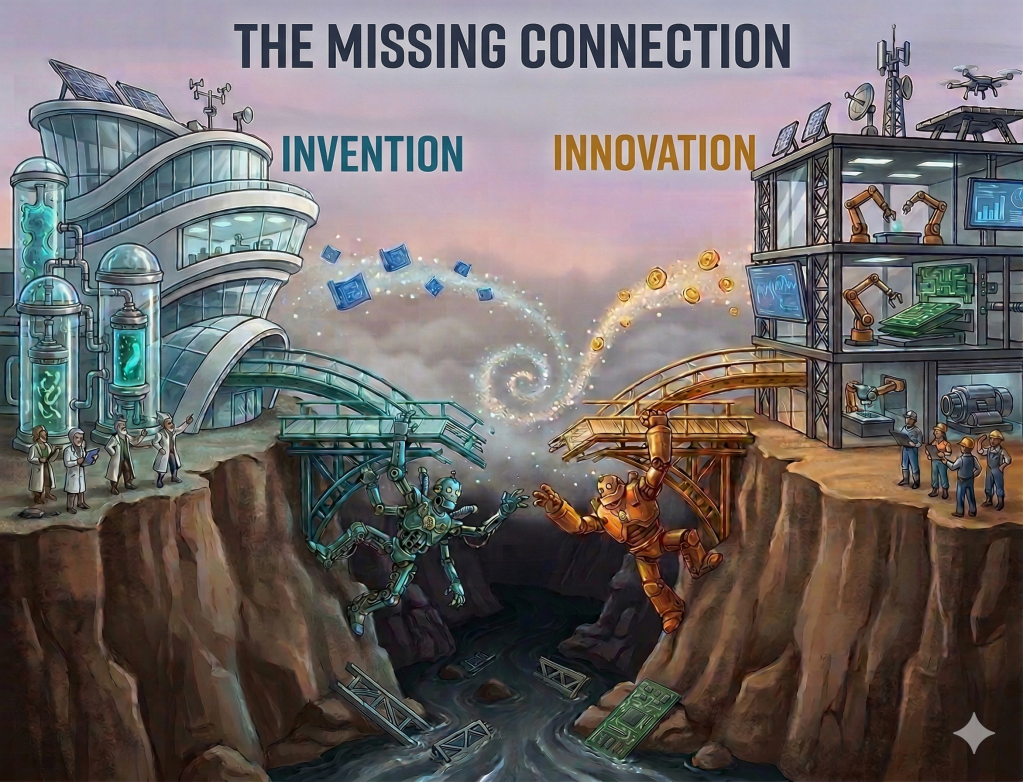
The Bridge That Was Never Built
This is the second of three posts on innovation: what it actually is, how it differs from invention, and how technologies evolve through the construction of domains, translation into products, and the specific kind of leadership each phase requires.
In my previous post I argued that the AI revolution has not yet happened because AI’s domain is incomplete. The supporting infrastructure, including reliable evaluation, memory and grounding, integration standards, accountability frameworks, models of human-AI collaboration, is being built, but it is not here yet. The spark exists, the system does not.
But the argument that the domain is being built makes the implicit assumption that all inventions will eventually become innovations. History, and my personal experience do not support this assumption. Invention and innovation are not just conceptually distinct; they are organizationally distinct. And that is one of the main problems that stifles innovation. The organizational gap between the people who are the inventors, and those who are the innovators is where most inventions die.
I have been thinking about this gap for most of my career, and experienced it first hand, for different reasons, in small and large organizations. The AI field, and all technology fields, as a matter of fact, has a long history of building things that were ahead of their time and then watching them fail to reach the world. That happened, in many cases, not because the technology was faulty, but because the bridge between invention and the need for it was never built, or it was built partially. This post is about that gap: what it is, why it persists, and specifically what kind of leadership it takes to close it.
The Question I Left Open
The question I did not answer in my previous post is: how do inventions become innovations, and how do they eventually contribute to the building of a domain?
The word domain, as W. Brian Arthur defines it in The Nature of Technology, refers to the coherent and established set of components, standards, practices, and infrastructure that makes an underlying technology or principle reliably exploitable. To Arthur’s definition I would add one element: a stable ecosystem of industries and economies that grow around the technology and depend on it. All mature technologies, throughout the history of the modern era, transform the world through the creation of such a domain. The presence of a domain is what drives a real technological revolution, not just the invention that sparkled it.
The invention of the printing press is one of the most clear historical examples: it did not change the world by itself. The domain it made possible, standardized spelling, distribution networks, literacy infrastructure, copyright concepts, took over a century to assemble. The invention came first. The transformation came later, and it came through the building of the domain.
Going from an invention to an innovation, and eventually seeding the building of a domain is not just a technical and economic process. Indeed, one of the most important factors are the human and organizational mechanisms. During my career I have been on both sides of the divide, the invention side and the innovation side several times, and I have come to think the gap between what is technically possible and what reaches the world is a translation problem, the translation of an invention into what provides value to the world. And type of translation requires a specific kind of leader that most organizations neither recognize nor cultivate.
Xerox PARC: The Perfect Invention Environment
Xerox PARC in the early 1970s is a textbook case for understanding the difference between invention and innovation, why the translation between them so often fails, and how inventions can eventually find their way into innovations through paths their original institutions never anticipated.
During that decade, PARC invented the graphical user interface, the mouse, Ethernet, laser printing, object-oriented programming, and the Alto, the first research prototype of a personal computer. Bob Taylor, manager of PARC’s Computer Science Laboratory, recruited brilliant people and actively shielded them from corporate pressure. The conditions were ideal for invention: psychological safety, organizational patience, deliberate cross-disciplinary collaboration. The researchers were world-class, the inventions were groundbreaking.
Unfortunately, Xerox captured almost none of the potential innovation value.
The standard explanation is that Xerox’s leadership lacked vision. Extensive interviews with PARC researchers and Xerox executives, documented by Douglas K. Smith and Robert C. Alexander in Fumbling the Future and by Michael A. Hiltzik in Dealers of Lightning, tell a more nuanced story. Xerox leadership understood the significance of what PARC was producing. They had, after all, funded it generously and given its researchers unusual freedom to explore. What they could not do was bridge the gap between the inventions and a viable commercial model. Building the Alto cost roughly $12,000, and Xerox executives, whose mental model of the world was built around recurring revenue from copiers, could not imagine who would pay that for what looked to them like an expensive typewriter. They were driven by the fear of cannibalizing the company’s profitable business with anything that would displace paper copies. Thus, no effective mechanism was ever created for technology transfer from PARC to Xerox’s manufacturing and marketing divisions. The engineers at PARC spoke the language of “user empowerment” and “bitmapping.” The executives in Rochester spoke the language of margins and service contracts. Nobody built the bridge between those two vocabularies, which is another way of saying nobody performed the translation.
When Steve Jobs visited PARC in December 1979, he was not only evaluating a research project. He was imagining how a non-technical person would feel sitting in front of a screen, with a mouse and a graphical interface. That shift, from the vast potential of a new technology to what a specific person will actually experience, is one of the cognitive acts that drives innovation. It is a fundamentally different perspective from what drives invention. Jobs took the invention out the door, to Apple, across the gap Xerox had left unbridged, and on the other side he created the Macintosh.
In reality, both the Lisa and Macintosh projects were already underway before December 1979, and Apple was already committed to graphical interfaces. The visit was more of a confirmation of Apple’s vision than an out-of-the blue revelation. One PARC researcher who conducted the demo later recalled that in a single hour, the Apple team grasped the technology’s significance more fully than Xerox executives ever had. That observation is, in itself, the clearest possible illustration that translation requires a special type of talent that even skilled executives may not have.
A Three-Phase Framework
The full arc from invention to impact requires three distinct phases. Most organizations are built to execute one of them. Almost none are built to execute all three, and the phase they most consistently neglect is the middle one.
Invention
The invention phase requires freedom, patience, psychological safety, and fostered intersection across different fields, often called cross-disciplinary collision. Invention is additive: more ideas generate more problems that require more exploration, that lead to more solutions, more combinations, more inventions. The leader who builds this environment succeeds by recruiting talents and protecting them from higher-level leadership pressure. Mervin Kelly at Bell Labs, Bob Taylor at PARC, and Ed Catmull at Pixar have been leaders of this caliber. What these leaders share is not just charisma or product instinct, it is a specific ability to listen and understand the significance of the inventions, but also their limitations, and to challenge them. Leaders who surround themselves with validators rather than challengers kill the dissent that generates new ideas.
Translation
Organizations almost always fail to build, fund, or even name this phase. Translation, the word I use in this context to indicate the conversion of invention to innovation, is the act of recognizing, in an invention, what it could become in the real world, and what value it could bring to real users. It requires someone who has, simultaneously, a technical understanding of technology in one hand, and a clear imagination of products and the related human experience in the other.
Market research and product management, in my opinion, are not translation processes, even though they are related. Translation is a kind of visionary empathy: the capacity to look at something unfinished and feel, concretely, what it will mean to someone encountering it for the first time. This is what Jobs did when he visited PARC, and what Bezos realized by recognizing that Amazon’s internal infrastructure was itself a product that became AWS. It is what the Wright Brothers did when they looked at a biplane and saw not a scientific instrument but a vehicle that one day would carry millions of people and goods around the world.
The translation phase also requires one of the most difficult organizational acts: ruthless subtraction. Invention environments accumulate possibilities; translation requires killing most of them, and keeping only those that would make a difference. The freedom that allowed PARC scientists to generate ideas was exactly what made them incapable of translation: too many ideas had equal standing, no one had the authority to declare that one of them was the one that would change the world. The research culture often resists the violence of prioritization that is required for great innovations.
Deployment
Deployment turns a translated vision into something that works reliably and provides scale. It requires operational discipline, solid engineering practices, and the patience to iterate through the inevitable issues that appear when you take something new to market. There will be new problems to solve, that will require new inventions, or a redefinition of the product features. Deployment also demands a commitment to time horizons that do not fit normal incentive structures. Most transformative innovations take longer than anyone initially expects. Insulating the deployment effort from short-term pressure without expanding the time horizon is, again, a leadership decision, not a technical one.
Why Bell Labs Almost Worked
AT&T Bell Labs was the historical think tank par excellence, and it was probably the organization that came closest to covering all three phases. Understanding why it almost worked tells us something important about why Bell Labs cannot be easily replicated.
Until its breakup in 1984, AT&T was the regulated monopoly for all telephone services in the US. That gave it the unique ability to own both the research environment that produced inventions and the deployment infrastructure that deployed them. Bell Labs didn’t have to sell its inventions to anyone: it sold them to itself. The countrywide telephone network and the associated services were both the lab’s funder and its customer. The translation phase was almost invisible: when something worked in the lab, the researchers and research managers started a dialogue with the engineers who would deploy it as an innovation at national scale. As an example, the transistor was invented in 1947. In only a few years AT&T started to use it to replace vacuum tubes in telephone switching equipment and amplifiers. Hearing aids and radios were also the first consumer products made possible by the new invention and commercialized by AT&T and Western Electric around 1952.
The breakup of AT&T in 1984, the so-called divestiture, dissolved that structure, and Bell Labs never fully recovered its innate ability to innovate. The translation bridge was intrinsic to the organizational design, and not just performed by the heroic acts of visionary leaders. When the structure of the company changed, the bridge disappeared.
Andrew Odlyzko, a mathematician who worked at Bell Labs from 1975 to 2001, in his 1995 essay “The Decline of Unfettered Research,” identified a further and more systemic cause beyond the AT&T breakup. He argues that the conditions for unconstrained research disappeared not primarily because of management decisions, but as a product of the increasingly faster and more global development of science and technology. The explosion in the volume of research around the world, the steady progress across all areas of technology, and the increasing pressure to put existing knowledge directly to work in products, rather than generating new scientific foundations, were, according to Odlyzko, the primary causes of the decline of unfettered institutional research. In a world where the integration of existing technologies is increasingly fruitful, the case for open-ended curiosity-driven inquiry becomes structurally harder to make. Unfettered research had become almost entirely absent from industrial labs, not because executives lacked vision, but because the economics of knowledge had shifted.
Odlyzko suggests that broad programs directed at promising areas, but structured to leave substantial freedom to individual investigators, may be the most viable path forward. Not total intellectual freedom, but a guided framework that still leaves researchers free to follow their own instincts within it. This matters because it suggests that the invention environment of the coming decades will itself be a negotiated compromise between curiosity and mission. The translation leader’s job is thus harder than it was during the golden era of Bell Labs, because the inventions themselves emerge from environments that were never fully free to begin with.
The Collapse Patterns
When the translation phase is absent, the pattern of failure is remarkably consistent. I have seen versions of it in my own career: research results that were real, technically sound, even ahead of their time, but that never crossed the gap into something a user could actually encounter. When well-funded research organizations fail to generate innovation from sound inventions, the problem is rarely the quality of the research. It is the absence of someone whose formal job is to stand between the invention and the market, and who has both the competence and the vision to do it.
Nokia’s research division envisioned the smartphone revolution years before it happened. They built touchscreen prototypes and wrote internal memos; the inventions existed. But Nokia’s leadership was hierarchical, risk-averse, and focused on protecting margin on existing hardware. There was no one whose job was to stand for the vision of the smartphone revolution and put Nokia at the center of it. As a result, the translation phase did not happen. Nokia’s former chief designer Frank Nuovo confirmed in a 2012 Wall Street Journal interview that the company had developed a color touchscreen prototype as early as 2000, up to seven years before Apple’s launch. A separate internet-ready touchscreen prototype developed in 2004 was killed by management, three years before the iPhone debuted.The most rigorous scholarly account of this failure is Lamberg et al., “The Curse of Agility,” published in Business History in 2019.
Steven Sasson built the first portable digital camera prototype at Kodak’s Rochester lab in 1975; the corresponding U.S. patent was granted in 1978. Kodak spent the following decades failing to act on what its own engineer had built. Leadership could not imagine the cannibalization of their own business model based on film cameras. By the time the threat of digital cameras became undeniable, it was too late for Kodak to act on it. Sasson has stated that Kodak’s marketing department was told it could sell an early digital camera but chose not to. Kodak filed for bankruptcy in 2012.
IBM Research is a particularly instructive case because it is not a clean failure. Since its inception in 1945, IBM Research has produced an extraordinary number of potentially disruptive inventions. To name a few: the relational database, DRAM memory, the RISC processor architecture, the scanning tunneling microscope, the hard disk drive, statistical speech recognition, and more recently foundational work in quantum computing and transformer-based language models. But its translation record has been strikingly uneven. Edgar Codd invented the relational database at IBM in 1970, publishing his groundbreaking paper in Communications of the ACM. However, IBM’s own product organization was slow to commercialize it, for the same old reason: fear of cannibalizing its existing IMS database business. Oracle reached the market first with a commercial relational database in 1977; IBM’s DB2 followed in 1981. The RISC architecture, created first at IBM by John Cocke in 1975, was similarly underexploited internally while MIPS, Sun, and eventually ARM built billion-dollar businesses on the same principles. IBM only followed through with its RS/6000 and PowerPC lines years later. The pattern is not that IBM lacked translation leadership entirely; the hard disk drive and mainframe businesses show it could translate when it could align the organizational incentives. But IBM’s translation mechanism was often blocked by the business units most threatened by the new invention. The bridge existed on paper, but in practice the incumbent businesses controlled the gate.
Microsoft Research follows a related but distinct pattern. For years it was one of the most talented research organizations in the world. It envisioned mobile computing, search, and cloud well before they became mainstream. The failure was not about missing or blocked translation, but mostly about culture. The era under Ballmer favored stack-ranking of researchers and engineers, which turned brilliant people against each other rather than making them collaborate toward shared problems. As Kurt Eichenwald documented in “Microsoft’s Lost Decade” (Vanity Fair, August 2012), every current and former Microsoft employee he interviewed cited stack ranking as the most toxic and destructive process inside the company. The translation layer was not blocked by incumbents protecting turf; it was dissolved by a performance culture that made the collaborative risk-taking that translation requires too costly to attempt. The talent was present. The environment destroyed the conditions under which translation could occur.
Theranos is worth examining as a perverse inversion. The failure there was not the absence of translation leadership but its pathological excess: charismatic vision without any corresponding invention. This pattern, in less extreme forms, is common in sales-driven companies, where the story of value tends to outrun its creation. Theranos simply took it to a criminal extreme. Elizabeth Holmes could describe what a product would mean to a patient vividly and compellingly. She could not produce the underlying technology. The translation phase escalated out of control and consumed the invention phase entirely, producing fraudulent marketing and sales rather than innovation. The three phases are jointly necessary. Translation leadership without honesty is not visionary; it is dangerous, and criminal.
What Visionary Leadership Actually Means
We use the word visionary so loosely in business that it has nearly lost its meaning. Here I use it precisely: a leader who can look at an invention, recognize the value it could bring to the world, and build or reorganize around that recognition with enough conviction to make it happen.
This is not the same as generating the original idea, the invention. Jobs did not invent the GUI. Bezos did not invent cloud computing. What made them visionary was the specificity and force of their translation: they could see, earlier and more clearly than anyone else, what a given invention was for. And they were willing to reorganize their organizations, sometimes ruthlessly, around that perception.
The operational mechanism is almost always the same: the visionary leader creates an environment in which bad results, contrarian ideas, and early failures surface quickly. We associate vision with confidence, not with openness to being wrong. But every leader who successfully navigated the translation phase was, in practice, a relentless and patient learner. They held their vision of the destination firmly while remaining genuinely curious about everything they did not yet know about the path.
This combination, fixed destination and open path, is what distinguishes the translation leader from both the research director, who may not have a destination in mind at all, and the pure operator, who is executing against an established roadmap. The translation leader is building the roadmap in real time, using the invention as raw material and human need as the undisputable compass.
Back to the Spark
Part I of this series identified five concrete gaps in AI’s incomplete domain: reliability and evaluation infrastructure, memory and grounding, integration standards, trust and accountability frameworks, and effective and stable human-AI collaboration models. These are the domain-construction issues that stand between AI’s current capability and its potential transformation of how people work and live.
But identifying the gaps is not the same as closing them. The question this post has tried to answer is: what kind of work and organization does closing them require, and what kind of leadership does that demand?
The answer is translation leadership. The five gaps I described will not be closed by the researchers who study them, nor by the engineers who deploy AI systems at scale. They will be closed by leaders who can look at a research result, a prototype, or an architectural idea, and see what it could become, and who have the authority, conviction, and risk tolerance to reorganize around that vision. History suggests those people are hard to find. They are rarely in the labs, rarely in the product organizations, and almost never deliberately cultivated. They tend to show up at the margins, often uninvited, sometimes from entirely outside the organization.
Odlyzko’s deeper point sharpens this further. The invention environment itself is under structural and financial pressure. The pool of freely generated research that translation leaders can draw from is shrinking, shifting from industrial labs toward universities, open-source communities, occasional well-insulated skunkworks, and very few VC, often highly funded, initiatives. Even though all of these sources of investigation can produce the right inventions, the bridge matters more precisely because the conditions on both sides are changing.
Organizations consistently overinvest in both ends of the innovation arc and underinvest in the middle. They fund research labs and they fund product teams, but they rarely cultivate or even recognize the translation layer that connects them. When an invention fails to become an innovation, the post-mortem almost always focuses on the wrong things: the technology wasn’t ready, the market wasn’t ready, the timing was wrong. Almost never does the post-mortem conclude: we had no one whose job was to stand between what we knew and what the world needed, and build the bridge.
Xerox built one of the greatest invention environments in history. It never built the bridge. Steve Jobs was the bridge. He just didn’t work there.

 THE VOICE IN THE MACHINE
Leave a comment